

“it’s not about how to catch, it’s about how to enjoy.”
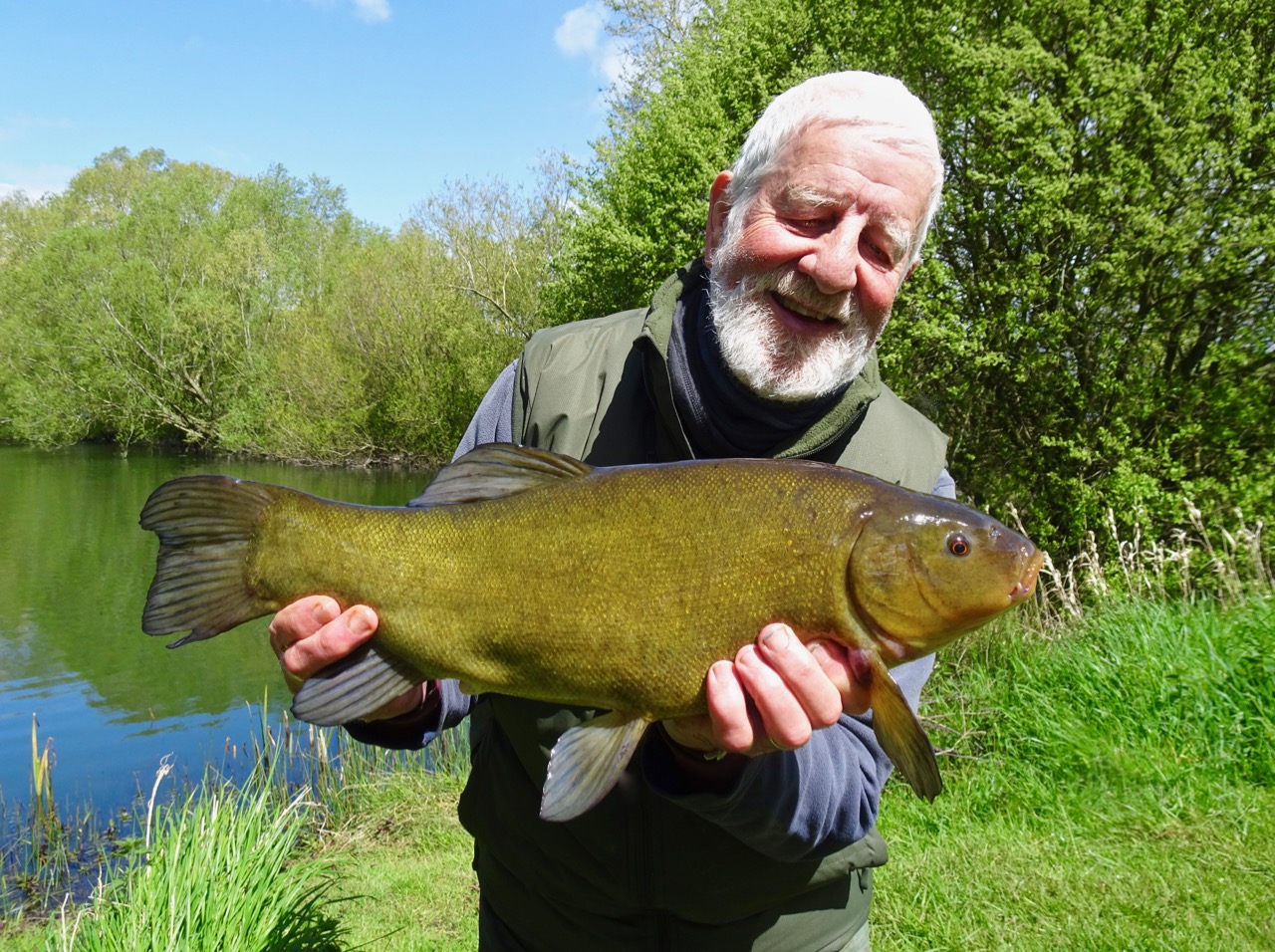
Luckily I’m a mad keen birder, so this year I picked a lake in the Cotswold Water Park that provides a daily symphony of song. Sleeping in my waterside camper van, I’d be literally up with the lark to search for one of the most desirable of wild creatures, a tench … and if I was lucky, I might even catch one. So from the first glimmer of dawn, it was enjoyment all the way.
The water is beautiful, part of a tree lined wetland surrounded by several lakes along with grazing dairy herds. It’s as peaceful a spot as you will ever find in southern England and with the park boasting a bird list of about two hundred species, I was sure there would be plenty to enjoy when the tench weren’t biting.

Upon arrival in the early morning of April 13th, the bird song was deafening, a cuckoo calling incessantly and leading a choir of blackbirds, blackcaps, chaffinches and wrens.

Even more magical was the evocative bubbling of a nearby curlew, the plaintive cry of an increasingly rare bird, though still happily nesting in this wildlife haven.


After all that song I hardly needed to fish because my chosen lake was decorated by many wildfowl and its’ tranquil acres were also large enough to provide the essential mystery that the best fishing requires. The lake is crystal clear, deep in places and very weedy, in fact, a perfect home for tench.


It also holds large bream, pike and perch, along with a few giant carp which were ancient when I used to fish this lake more than twenty years ago. Their rarity means that I can fish peacefully without the anxiety of my tench tackle being beaten up by a monster.

Being past my sell by date, I find that using the fishing methods I enjoy most are more important than catching fish, so instead of casting out the more efficient bolt rigs, I choose a float, dangled delicately below a pole. So my first priority was to find a swim with deep margins that would give me a chance of catching a tench on a long length of space age carbon. I raked the bottom to clear a narrow channel through the weed and hoped the stirred up bugs would attract a snuffling tinca.
Nothing happened for hours in spite of intense concentration on the tiny tip of my pole float. In fact it was dusk before bubbles appeared in my baited spot and the morsel of worm on my hook proved too tempting for a hungry tench to ignore. It slowly pulled my float under until I struck and those delightful sensations of contact with a wild creature could be enjoyed, even if tempered by the fear that the line might snap. A violent battle of wills followed as the pole elastic stretched close to breaking point and my anxiety increased.

Tench fight hard for survival but they have no need to be afraid, for within moments of being scooped up in the landing net, my prize was released to swim free, back into its’ watery home. Weighing over five pounds, it was a promising start to my mini holiday and with darkness descending, the lowering of head on pillow followed rapidly, though only after a splash of red wine to celebrate success.

Dawn arrived all too quickly, though more than welcome because of the relentless calling of cuckoos close by as I enjoyed a cuppa and bacon sandwich. Walking to my fishing spot past this wonderful sunrise, several great crested grebes hunted for breakfast and when one came up with a large signal crayfish, I gave a silent cheer.


American signal crayfish don’t belong here and they have colonised so many waters that they are now a serious threat to our freshwater biodiversity, so no wonder I was pleased that grebes enjoy eating them.

Several pairs of grebes nest on the two lakes but one close to my swim was having a terrible time with one rapacious crow. Every time she laid an egg on her waterlogged nest, this particular crow was watching and as soon as the female grebe went off to fish, he’d be down to snatch the precious egg.

The crow and his mate terrorised the neighbourhood, wiping out many mallard, moorhen and grebe nests. They were also notorious for stealing anglers bait and on several occasions I had cause to chase them off.
However, when we reported their nest robbing greed to the local game-keeper their days were numbered … and now the pair of grebes have relaid eggs safely and are raising their family unmolested. There are some notable conservationist that think we shouldn’t ‘remove’ any predators but with so many vulnerable species declining alarmingly, I believe we need to find a balance so that every living creature has a chance to recover their numbers, not least the lowly moorhen.


As for our fishy wildlife, the annual invasion of 40,000 cormorants from abroad are a nightmare and are seriously depleting fish stocks in so many freshwaters, to the detriment of other hunters such as grebes, herons, little egrets and even otters. Luckily, all of these still thrive where I’m fishing so that I’m able to enjoy their competition.

The next pic is of a duck I didn’t even recognise, though it looks like a cross between a goldeneye and an American bufflehead. I’m guessing it’s a crossbreed from someone’s wildfowl collection but maybe a reader can identify it as I always find it exciting putting names to rare birds.


The lake is a magnet for many species of duck and at risk of making a list, there were numerous mallard and tufted ducks, a few gadwall, a pair of shoveler to go with those regular waterfowl, coots and moorhens along with several exotic looking red-crested pochard.

There were also numerous geese, not just the Canadas with their impressive creches of up to seventeen young but Egyptian geese too which, like the cormorants are all foreigners.

While admiring all this wildlife, I had reverted to the more modern technique of using ledger tackle at range in order to add to my tally of tench, so clipping up my rods and spombing at seven wraps, I fished either a maggot heli rig on one, a worm kebab on another, then an in-line rig on the third. However, I didn’t use all three at once, especially as I had rigged my float rod with a waggler to fish at the bottom of the nearside shelf and this required intense concentration.

All these techniques produced some tench, even when challenged by the cold spring weather and the line was freezing in the rod rings. I thought I must be mad tench fishing in such weather and I guess I was but a little madness is part of the disease that afflicts all of us passionate anglers.

In spite of the cold spring the birding remained as good as ever, the highlights being the birds of prey, for buzzards were building a nest in the willows beyond my swim, a pair of kestrels likewise nearby and frequent sparrow hawks but the fear of god into the blackcaps and long tailed tits, though on one bizarre occasion, I watched a cuckoo chasing the hawk along the side of the lake.

One of the greatest and most unlikely highlights one sunny evening was a pair of goshawks displaying right over my head and given how few big woods there are that are suitable for them to nest in the area, it was hardly believable. However, I had spent two years making a goshawk film around Britain for ITV which sold all over the world, so I was not mistaken.

My bird of prey book shows how the female's undertail-coverts are fanned out when displaying and the pair I watched were making a good show of it just above me, the best I had ever seen in spite of two years filming them. The male with a rat below clearly shows it's fanned undertail feathers too.

While all this bird action was going on, the cuckoos continued to drive the reed warblers mad with their nest scullduggery and as they flew back and forth across the lake, they serenaded me relentlessly.


This marvelous painting was created by Rodger Mcphail for our 'Passion for Angling' book and should have been in colour of course, but for some inexpicable reason, the budget conscious BBC decided that bl/wt would do. Wrong!

What a delight all these birds were, especially that even when distracted, I still managed to catch several tench up to a little over seven pounds.


There were red kites passing by too, and given they were so rare when I was a boyhood birder searching for them in the oak woods of central Wales, it’s always a highlight of the year when I see these most graceful flyers. What’s more, their transition from rare to common just proves that not all wildlife bird news is bad!


I was not alone in my enjoyment of the lakes and their wildlife because friends Mark Woodage and John Costello fished nearby and so we were able to share our success’s and bemoan our failures, which were many! When it comes to big fish, I’m a lightweight and preferred to fish what is considered to be the ‘easier’ of the two lakes but Mark and John are proper anglers and fished the larger and weedier lake.

They had to wait a lot longer for a bite and even if their tench were bigger, I like action and argued that size doesn’t matter. I don’t believe that for a minute of course and even after sixty years of fishing, I’m still waiting for my first double figure tench so tried this 'pier' swim on the 'hard lake' for three days and never had a bite! It's a beautiful spot to blank though, isn't it.


One more surprise swam up to me one damp evening when ripples suggested an otter was approaching but the binoculars revealed a beaver! I have filmed them in the States but never seen them in Britain and never even knew they existed in the Cotswold Water Park, so I was surprised and delighted, especially when it chewed some willow branches close by, as if to confirm that I was not hallucinating and this was no fish eating otter. It seems that we’ll all be getting used to seeing beavers more frequently in the future, though judging whether this is going to be a good thing or not is a debate for another time.

Drifting off to sleep that night, I could here the distant calls of a bittern and had to pinch myself to ensure that I wasn’t dreaming. However, much of what I had enjoyed there this summer was indeed like a dream come true and goes to prove that there is more to fishing than catching fish.


