Showing posts with label Norfolk Broads. Show all posts

Wednesday, 16 October 2019

OUR ENGLISH COUNTRY GARDEN IS BUZZING


 salvia atrocyanea with ubiquitous common carder bee - they LOVE it
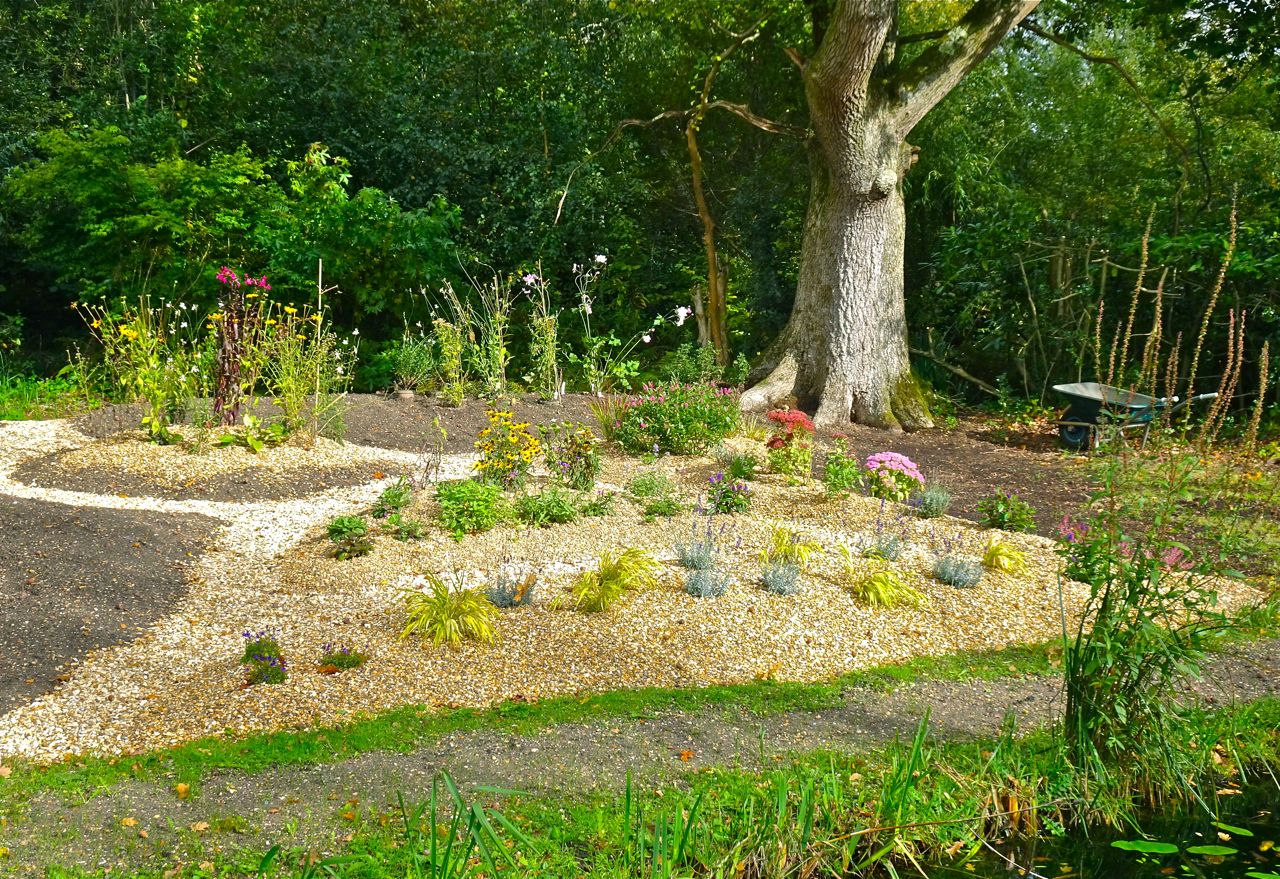
Inspired by the need to help bees and butterflies and then encouraged by this years Dorset Wildlife Trust campaign to get Dorset buzzing, we set out three years ago to create a gravel garden that would enhance the attraction of our little patch of wildlife heaven. What follows is the story of our ‘work in progress’ -

    ‘CREATING A GRAVEL GARDEN FOR THE BUZZERS’


We started by visiting inspiring gardens such as Beth Chatto’s where she dug up her car park to create a stunning gravel garden, then reading books and seeking advice from our delightful Knoll Gardens near Wimborne.

as tall as our cottage, the bamboo thicket on the right is the chosen spot for our creation - lots of hard work ahead!
The site we chose picked itself, for it is the sunniest area in our wooded two acres. Trouble was, this large patch was a forest of invasive bamboo, so tall and thick that giant pandas raised young in it!

cutting the bamboo provided a lifetime of kitchen garden poles and allowed us to admire our lovely oak tree behind
If you’re wondering what the scaffold is there for, we were building ‘Hugh’s Folly’ at the time, a picture window that looks out over our frog marsh and as it faces east, allows us to bask in the sunrise of winter dawns. It’s beautiful but cost twice as much as estimated and took twice as long to build, hence the term ‘folly’!
a timber framed 'folly' maybe, but warming in a winter sunrise overlooking our frog marsh is a delight


in the summer it's a very wild garden - just as we like it
winter pollarding and pruning - and progress clearing the gravel garden area on the right
Clearing the bamboo jungle was the first priority and after a couple of years of sawing and digging bamboo and snowberry roots, along with a jungle of bramble and ivy, we had the beginnings of a workable site. 
bottom left is our chosen spot, sunny in the summer but we'd hardly started even clearing it
But other priorities got in the way and all the roots started a riot of growth once again and removing them was getting ever more difficult.

blink and the jungle returns - bamboo and snowberry growth is relentless

There was also the smelly matter of an old toilet soak-away buried under all this growth, left over from the days when there was a privy outside our ancient cottage. 

a glass plate pic of our old cottage built on sunny heathland before the top story was added in 1910
The three thatched cob dwellings are shown on maps dating 1747, set in a heathland habitat and when we first moved here thirty eight years ago, the area behind the house was still heathland and had a population of stonechats and linnets. The extraordinary speed of the oak and birch growth behind the cottage since living here still surpises us every week.
the cottage has changed a bit over the years but look at the growth of the oaks and birch behind the cottage - awesome
After many weeks we had cleared the site but still had the problem of deeply buried tree and bamboo roots and had to remove them without damaging the roots of our majestic oak tree.
what a beautiful tree - 100+ years old and growing fast - the gravel garden will be on the left

the fibreglass skin I'd added to the wood survived under the compost heap
Buried underneath the jungle of roots was a compost heap for grass snakes and slow-worms, covered by my old boat that in my early twenties enabled me to row around the Norfolk Broads, looking for birds and fish.


making a start between the stream and main pond
Then we had to remove the soak-away and tree roots and it seemed the only way to achieve this was with a mini digger. Enter fiddle player Steve Brown who plays in Irish bands at ceilis but by his own admission is even more skilled and artistic with the blade of a digger.
it's a big area and needs all the roots and ivy stripping off - a digger made it possible

Steve making excellent progress
piles to fill many barrow loads - good excersise
dismantling the woodland privy soak-away and filling the hole with roots and soil
roots all dug out and cleared and almost ready for covering - didn't he do well!
several layers of tarram left for two growing seasons would kill any growth below - we hoped!
In just a few hours he had everything dug up and the site levelled, so all I had to do was barrow the mountains of bamboo root away and we were ready for the next stage.
 a lovely tidy job created by Steve and now we could make a start creating our dream garden for buzzers

after nearly two years it's almost ready for removal, then the hard work of tons of soil, gravel and planting can commence
The advice was to cover the area with an impervious membrane for two growing seasons in order to kill anything still hidden below, so after laying five layers we waited patiently until dragging it off a couple of months ago. It was so encouraging to see that it worked and hardly anything had survived the dry darkness we’d created.

we were advised by Knoll Gardens to create raised areas of soil and gravel so the plants were free draining
Because the area lies between a stream and a large pond, friend David and I laid 23 tons of soil in hills to ensure the plant’s roots were above any damp soil. Then came the expensive purchase of bank-balance breaking numbers of plants loved by bees and buzzers. Planting could now commence.

barrows of delight for bees and butterflies
We purchased seemingly endless numbers of lavender, hebe, salvia, aster, nepeta, echinacea, rudbeckia, lobelia, gaura and several others, [blimey, I sound like an expert] and it was so exciting to see all the wildlife buzzing in to take advantage, sometimes flying onto the plants before I’d even put them down, let alone planted them.
paths through the area will become less formal as the plants grow

 we mulched the new plants with 2" of 10mm gravel to keep them moist but weed free - dream on!

aster nectar for hoverflies that arrived within minutes and we have a years planting still to go - exciting times
The bees have come in squadrons and we’ve hardly started, so once I’ve secured another mortgage from the bank so we can afford to buy the spring and summer delights, by next autumn the area should be pure joy. Then comes the fun of learning to identify all the insects that we’ve attracted to this lovely little corner of sunny Dorset.
silver-washed fritillaries love hebes


The Dorset Wildlife Trust’s campaign to encourage members to plant for invertebrates ‘Get Dorset Buzzing’ has been an impressive success. They hoped to win support from about 1,000 and have now attracted upwards of 4,000 so well done to them all because it’s great for bees and for all those other pollinators that are so essential for our own long-term survival.

In the meantime, we’ll just keep digging for England. Flowers, colour, bees and butterflies in our gardens. What’s there not to like!

Wednesday, 27 April 2016

UK NATIONAL FISH VOTE

a lovely brace of River Kennet biggies while filming 'Catching the Impossible' with Martin Bowler - the best went 2lb5oz

I’m going to nail my flag to the mast and vote for the roach because I believe it should be the national fish. Thriving in every sort of water in Britain and available to all, it is not only beautiful but if you’re seeking a big one, a real challenge ... so please excuse me if I show a few too many pics of the rare moments when I got lucky.

a scale perfect roach and close to three pounds
roach live in some beautiful places too
Many of you will be aware that there is a vote in progress that is going to lead to a decision on what is to be the nations favourite fish. It might not be as important as deciding whether to leave Europe or stay but it sure is worth a moment or two of your time.

The idea and initiative has been created by our very own underwater hero Jack Perks. He is masterminding an attempt to raise awareness of our fishy wildlife and we owe it to our watery critters to get behind him and VOTE. After all, the birders among us recently chose the robin as our national bird and we don’t want them to think we don’t care about fish.

So this is the link which will enable you to get behind the venture and make the general public sit up and pay more attention to our fishy wildlife and the places they live ... and who knows, they might even respect us anglers more too.


Jack has managed to gain the BBC’s support by having the vote publicised on the ever popular ‘Springwatch’ so several million will be aware of his initiative.

Ely Cathedral was the place I grew up and thanks to the Great Ouse nearby, also became a fanatical roach angler
I chose the roach because it chose me, for when fishing in the Great Ouse at Ely as a child, I caught a big one by design. We normally caught  just small fish, a few roach along with gudgeon and perch off the wall at the Cutter Inn but one day I cast a lump of flake to a large bed of cabbages and fluked a 10oz lump which to this small boy was a monster. I was hooked for life and have been trying to catch big roach ever since.

a Hampshire Avon two from the good old days
Luckily I grew up in the glory days of the H.Avon and Stour when two pounders were the expected catch and I had dozens, even managing a three pounder from both of those rivers and all on trotted bread flake. I even managed two pounders from the Broads, notably from the River Bure and Wroxham Broad, often using cheese paste as bait. This was in the 50’s when it seemed big roach thrived everywhere.

To catch the Broads roach I’d cut up Kraft cheese slices into small particles and scatter them around the float and it worked a treat ... but not before I’d used a quant pole from our cabin cruiser to poke around the bottom to find gravel runs. There was a particular patch on the start line of the sailing club in the middle of Wroxham Broad and though I irritated the sailors at race starts I caught many big roach from the spot, especially in the middle of the day, perched in my little 8ft plywood dingy. Happy days for sure ; I wonder if they’re still there?

2lb6ozs - fat as butter but not taken on cheese

I learnt the cheese technique when fishing with the old boys on the Regents Canal at Paddington in the school holidays. It was good roach fishing and if using cheese paste using a small porcupine quill, we’d avoid the small ones and catch them to over a pound, my best going one pound two.


The bait also worked well on the Serpentine where I caught numerous good roach but never as big as a pound. Unfortunately the bait also attracted eels and when struggling to unhook an above average wriggler, an old lady ran up and angrily telling me I was a cruel boy, beat me over the head with her umbrella!

I’ve tried the cheese technique in notable roach water several times since and never had a bite, though this is one of the joys of roach fishing. You can never be sure where or when you are going to catch a big ‘un, if at all!

good mate Trevor Harrop of Avon Roach Project fame with an Avon two pounder
We all know about the dramatic declines in roach due largely to the invasion of thousands of non-native cormorants but I’ll spare you a rant and simply celebrate the apparent recovery in several rivers, even in the iconic Hampshire Avon, not least because of all the work by the Avon Roach Project.
Trev releasing the future into the H.Avon and hope for keen roach anglers


Britford still produces two pound roach, largely because of the tireless work of river keeper Stuart Wilson in protecting them from the 'black death' .... that's cormorants if you hadn't guessed.

the LAA's river keeper extraordinair Stuart Wilson with one of his precious Britford roach
Still waters are providing some great roaching too, especially when they thrive under the radar, fattening up on carp anglers bait. Sway is just such a water, though Stuart thinks still water roach should only count as half and I kind of agree!

what massive roach those Linch Hill beasts were ... this one went 3lb3oz. caught while fishing with friend Gary Newman
The famous Willow Lake at Linch Hill produced amazing roach, even if they tended to be caught on 'unsporting' bolt rigs. I am guilty of trying the technique there too, just so I could see one of those huge roach you understand! I became known as a ‘jammy bar-steward’ because in only four visits I was lucky enough to catch a three pounder every time. In defence, I did try a sliding float and caught a few two pounders but never a three on the float.

admiring my PB of 3lb5oz - caught on a float too
I had roach to 3lbs4ozs at Linch but my PB came from Sway, just an ounce heavier but caught ‘properly’ on a delicate float. I also had my PB pole caught roach there too, an ounce under three pounds, so a much desired three on the pole is still out there to achieve. However, in my book any roach of a pound or more is a big fish and makes me a happy man and even if I’ve wasted a lot of my life in a quest for big ones I’ve loved every minute of it - well almost!

the pole can be deadly for really big roach
a gorgeous early morning two pounder - what beautiful fish they are


Sadly, a two pounder is now a distant dream on several once famous fisheries but the challenge remains and for me and many of my best pals, roach are still a constant cause of much head scratching and effort. So please get voting ... and if roach are the species that pulls your string, good on you ... but if not then still vote. I could easily have chosen tench or barbel, perch or pike, sea trout, mullet or bass, even carp for I love them all but as the saying goes, my favourite fish is the one I'm fishing for at the time. I just need to go out and fish more often!


beaut. 'nuisance fish' - carp are quite a struggle on roach gear!
As for my wife Sue, she loves tench, as I do ... but she says her favourite fish is the last one she eat!
time for tench

Saturday, 9 February 2013

RUDDY MARVELLOUS - ANGLING ADVENTURES 2


A midsummers dawn - simply the best time to be alive. The longest day had just passed and there was everything to look forward to as we headed towards the best of the years river fishing … but not yet.


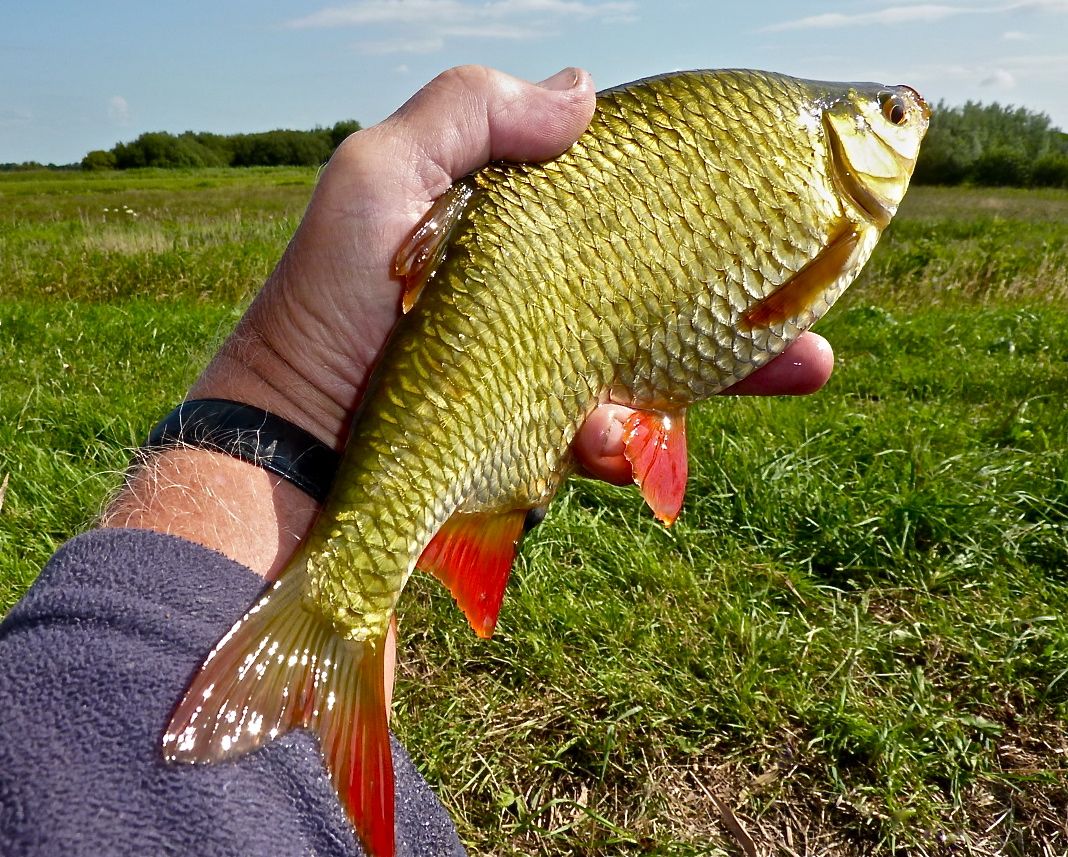
There is one species of fish that I have an even greater passion for than roach and that’s rudd. Growing up in the Fens at Ely on the Gt.Ouse and enjoying family holidays on the Norfolk Broads in the late 50's, I grew to love the gorgeous, golden beauties and even today the mere thought of them gets me excited.


Like many of my generation, I was inspired by Bernard Venables' book, 'Mr. Crabtree Goes Fishing' and still enjoy going down memory lane when looking at my battered copy. It's pleasing that the great man is being honoured with a TV series and new version of the book right now.

I was keen to 'live the dream', convinced Mum and Dad that I just had to visit the Broads and when finally there, carefully followed Bernard's lessons to Peter.


I only caught small ones when using the anchored bread trick, but remembered to keep my little boat well away from a large shoal I'd found in a remote corner of Hickling Broad.

I really was 'living the dream'


In the evening I rowed back to them in my little dinghy and remembering to keep well away, made a long cast to the reed edge with bread flake under a stubby waggler. I caught 22 of them before it was too dark to see. The smallest weighed 1/10 and ten of them were over 2lbs, with the best going 2/5 and 2/3. I’ve never really recovered. 

Sorry about the bobble hat but I was only sixteen
With so many happy memories still fresh in my angling memory bank I had to return, so this last two years I’ve made a pilgrimage back to the Fens, exploring the rivers, drains and lakes in the hope of beating my PB of 2/9, a figure I’ve managed to equal in five different waters, including Ireland … one day I might beat it … one day?

red maggots lured them in front of the camera
2/11 and 2/9 - a perfect brace


I had my chance when filming 'Catching the Impossible' with Martin Bowler, a shoal of 14 large rudd swimming beside us in the crystal clear water. I had to film the underwater shots first, then Martin had to catch a couple for the camera before it was my turn. Sadly, my turn never arrived because the shoal just drifted away ... one day ... one day.

 tranquil tench time
In 2011 I tried the River Cam and the drains and lodes, the first time I had fished them for fifty years. Back then, us energetic schoolboys used to cycle over there from Ely, catch rudd and then cycle all the way back. Funny how the wind was always against us whatever direction we were travelling! It’s still a wonderful place, 'the land of sky’, as inspiring as ever and even better now than in my childhood. 

The Land of Sky
c. Danny Green
c. Richard Brooks
Wicken Fen didn’t have breeding marsh harriers and bearded tits then but it does now. I spent as much time birding as I did fishing, harriers regularly drifting over cruisers on the Cam, the occupants blissfully unaware poor souls. In 2011, I managed rudd to 2/4 so a return to the Fens was inked into the diary, especially as all the  locals like Chris Hammond had made me very welcome.

Fish don't get any more beautiful do they?


Yes, that is a swing tip - very effective too
Last year, with help and advice from Graham Tweed – thanks Graham – President and Sec. of CFPAS – enjoyable company on the bank too – I decided to try Milton Country Park, a complex of crystal clear weedy lakes … classic rudd country. Friend Chris said he thought the decision was a bit ‘left field’ but ‘it seemed like a good idea at the time’! I picked the lake with the biggest ones of course and started well, the first rudd going a respectable 1/9. [No picture as it had two ugly cormorant slashes across it’s body]. However, I never managed another much over a pound and I blamed the weather. Strong wind and heavy rain battered into my face all week, the mud getting deeper and the rats more numerous.

I did enjoy the challenge though, especially when of all things, a marsh harrier hunted a nearby reedbed. It was such a rare bird when I grew up in the 50’s, restricted to just three surviving pairs but here it was now, floating over houses by the A14 in Cambridge – wonderful. Just goes to prove the cliché that there’s more to fishing than catching fish. It also proved that not all is gloom and doom out there in the wild.


I did catch plenty of small rudd, some splendid tench to 6lbs or so and several ancient, wild looking bream. They certainly were wild when hooked, one clearing the water by a good two feet. They all weighed about five pounds, their impressive bids for freedom making up for their lack of size, a highlight of the trip.

Believe me, it really did fight


The low point came at the end when the rats got to me ; a dose of what felt like Wiel’s desease or leptospirosis, the symptoms matching perfectly. I felt so awful I delayed driving home for a day. Hospital blood tests and stomach analysis were inconclusive but it took me three weeks to recover. Those big rudd still beckon though ; I saw them out there.