“Wildlife Film Maker Killed by Otter – from Sleep
Deprivation”
 |
| 28yrs old and a family treasure - killed by an otter in mid afternoon |
I can believe the headline
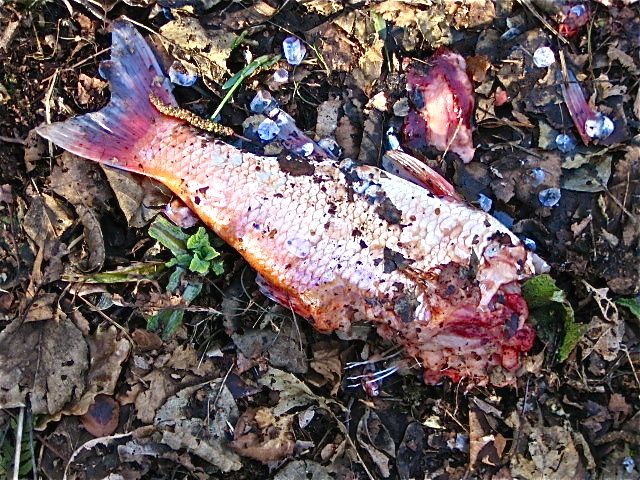
because I’m that victim. The time is 02.45 and the otter is just outside the
window right now, eating the last of our golden orfe. I have tried to keep it
away with a six foot fence and by lighting the pond, even shining a torch at
the ‘playful’ little otter as it runs around our garden but every night this
last week it has found a way in, keeping me awake in my futile attempts to
protect our fish. It’s all over now, the last fish has just been eaten, I’m
exhausted and the otter will go hungry.
 |
| just nine inches long - poor little fish |
 |
| the children's pet fish |
 |
| just orful - sorry - sick joke |
 |
| a prize rudd left for dead |
It is distressing and sad
when fish that have grown up as our children’s pets are killed, especially when
a healthy ecosystem is destroyed. The pond was a vibrant haven of life, native
fish such as rudd breeding successfully, weed growth flourishing, the surface
alive with dragonflies, damselflies and even mayflies, aquatic life flourishing, fed on by
mallard ducklings and minnows dived on by kingfishers. Now it’s all gone and
the situation is deeply disturbing.
 |
| home sweet home or otter heaven? |
 |
| a wildlife haven |
 |
| under siege last year |
 |
| midnight feast |
 |
| the remains of a once vibrant ecosystem - heartbreaking |
The final act was when the
otter absolutely trashed the place, ripping up lilies in order to eat the last few minnows. I feel
sympathy for an otter that is so hungry it has to hunt minnows. I also realise
that my losses are nothing compared to those that are trying to make a living
running carp fisheries and farming fish. There are big problems out there and I
naturally ask why?
 |
| chomping on a grayling c. Stewart Canham |
It’s easy to suggest that the
increase in the numbers of otters leading to competition for territory and food
is a contributory factor and more than likely it is. For a more significant
cause look no further than the cormorant, emptying the River Stour of silver
fish so that this young otter just outside my window tonight has had to travel a mile
from the river, over the A31, up a little stream across the fields and over a
six foot fence just to look for something to eat.
 |
| an Anglers Mail report - the dangers are real |
Adding to the problem is the 95% decline in eel numbers, a favourite food of otters. We can’t
change the fact that otters are fish eaters and that they are hungry. We can only hope that the government changes the law regarding
the right to protect our rivers and lakes from the ravages of the hordes of
hungry cormorants.
 |
| as appearing in the RSPB's Birds Magazine |
If we accept the scientific
evidence that each of the 23,000 cormorants that travel from the continent each
winter eat a pound of fish a day, then it is also easy to accept that removing
23,000 pounds of our native wildlife a day every
day throughout the winter is surely un-sustainable, especially in the long term. It is already having a detrimental
effect on our biodiversity.
Then we have the non-native
signal crayfish destroying fish recruitment by eating their eggs, an Oxford
University Study on the Thames calculating that there are 10,000 crays per half
mile of river. Now that is simply depressing.
 |
| Red for danger c. Stewart Canham |
 |
| one down, millions to go c. Ton Dopp |
Worse still, it seems that
most wildlife conservation organisations are either ignorant or are in denial
that our rivers face serious problems and when I try to explain what is going
on, they say I am wrong. If they had observed the declines that I have
witnessed these past thirty years, they would be moved to tears like me. As
I’ve said before, it takes ten years for a roach to grow to 2lbs and two
minutes for a cormorant to eat it, so we’re running out of time – fast!
 |
| the king of fishers c. Charlie Hamilton James |
 |
| down the hatch c. Roger Cresswell |
Being a lover of all
wildlife, I wrote to the RSPB’s Chief Executive, Mike Clarke. I have been a
member for over fifty years and ran their Film Unit for five years but when I
described what was happening out there and the loss of fish eating birds, [three
local pairs of Great Crested Grebes for starters], he as good as told me I was
lying. In fact, despite telling me so, he had no evidence that grebes weren’t
in decline because when I checked with the British Trust for Ornithology they
told me that there hasn’t been a breeding survey since 1975. I was disappointed
by his dismissive attitude and alarmed that just because it’s got feathers,
he’s prepared to invent facts to protect the cormorants’ reputation. I
reminded him that there are lots of fish eating species out there and some
might already be struggling through lack of prey.
 |
| big but thin as a rake, caught on a 10mm boilie while barbeling |
 |
| predator eats predator |
 |
| bitterns c. Val Smith |
 |
| big bills but lovely birds c. Niall Benvie |
Sadly, we have to accept that
most wildlife enthusiasts aren’t even aware that fish life is wildlife and that it plays an important part in our freshwater
ecosystems. It’s up to us anglers to join the conservationists, to change their
attitudes, to educate them about life underwater … and the sooner we do so the
better. As a contribution, the attached film attempts to explain some of
the facts. I plan to do a lot more, but this is a start … and don’t knock me
for suggesting that the return of the otter is a conservation success story
with few parallels because it is. The otter is a problem because the freshwater
environment is in trouble and they are hungry but you have to accept that most
folk are excited if they see one and so am I, even in the garden! It’s a shame
for all of us that because we have filled the countryside with carp, they’ve
become the otters’ favourite food.
 |
| one of our big carp - pulled out of the pond into the stream |
 |
| another night of killing |
As many of you are aware, the thing that has upset a
lot of anglers is the thoughtless release of large numbers of captive bred
otters into an ecosystem that might not be able to support them, especially
after the 95% decline in eels. There should be a law in place that allows
Natural England to insist on an ‘Environmental Impact Assessment’ before any
release to protect the balance of nature and the otters, because the
increasing incidents of otters killing each other due to lack of space is
alarming. Deaths on roads have increased a lot too. Releasing an apex predator
into the wild should require a license. We should push for that, not seek to
control their numbers and shoot ourselves in the foot. No one will condone the
killing of otters, however valid it appears to be.
Otters are one of the UK’s most popular animals and my
wife Sue suggests that I may be partially responsible because in 1982 I made
the first ever film on wild otters for BBC1. It attracted an audience of a
staggering 17.3 million and it’s ironic that they were so rare then that I had
to travel all the way to Shetland to film them. Now one is outside in the
garden, eating the last of our fish.
 |
| great animals but trouble for fish c. Stewart Canham |
Everyone is claiming that no
further releases are taking place but it seems clear that this is a lie. Now
there is a report that otters are having re-productive problems due to hormone
disrupting chemicals in the water. So maybe the much celebrated return of the
otter is reaching a natural watershed? There are no easy answers!