Showing posts with label Mike Clarke. Show all posts

Tuesday, 9 April 2013

OUR RIVERS IN CRISIS


young otters are both cute and trouble with a capital T - c. Stewart Canham

a wonderful place for wildlife ... before otter
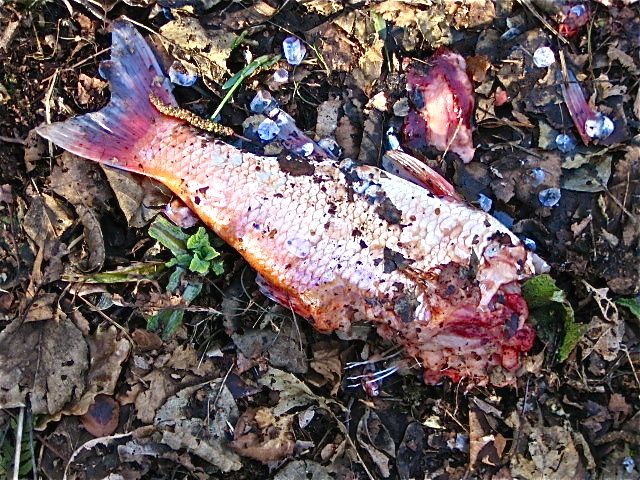
It’s dawn and our naughty little otter has just returned to the scene of the crime, her wet footprints leading away from the pond by our cottage, trashed even worse this time because there were only half a dozen minnows that had survived for her to hunt since the last attack. If that is all she can find to eat it is symptomatic of deeper ills and I certainly worry for her future and that of the rest of our rivers wildlife.

... and after ... the trashed and fishless remains

We used to be privileged to receive regular visits to our garden from kingfishers. They found a minnow banquet waiting for them, especially valuable when the river was a raging flood but what now? If kingfishers don’t eat for three days, they die. They have already suffered a 30% decline this past year.

Paintings by Rodger McPhail from our 'Catching the Impossible' book

male and female minnows in breeding garb
God help us if we believe what the media tell us about how good our rivers are now … and even worse if we believe that otters provide a ‘litmus test’ of the health of a river as told us by the BBC among others. I was taught that predator numbers are controlled by the abundance of their prey. So with otters having to hunt minnows in garden ponds and ten otters having been killed on Dorset’s roads in just three months before Christmas, I believe that this not only indicates an increase in hungry otters but a lack of suitable prey … and if you release captive otters into a river system, does that make the river healthy? No, I don't think so either.
RSPB's Mike Clarke with Minister Richard Benyon

the updated version - not much has happened!
will politicians ever look after our freshwater ecosystems?
water gives life to all, including us!
There are so many challenges in our freshwater environment and the RSPB knows that. Admirably, they combined forces with the S&TA and Angling Trust, along with many other NGO’s to produce the impressive “Blueprint for Water” in the hope that our government would protect this vital resource more seriously. It would be good if the RSPB joined with anglers as we try to solve the problems, not compete with us over a lethal fish-eating bird. 

some birders find them attractive


dramatic decline of roach in our local River Stour
We have shed-loads of scientific evidence proving that cormorants are contributing to the loss of balance in our freshwater ecosystems, so denying they are a major part of the problem is making a solution far more difficult. Their numbers in Europe have increased rapidly since the 1980's and EU research has counted at least 500,000 [some say 2 million], their highest number for more than150yrs. They have reached epidemic proportions and we need to act now.


simply too many eating too much c. Stewart Canham


Matthew Wright, Guy Linley-Adams, Paul Knight, Janina Gray
changing anything for the better is a long process
Last year I was asked by the Salmon and Trout Association to make a film for them about their legal complaint to the European Court accusing the government of not looking after our rivers, particularly those fragile and very rare jewels flowing through the countryside, our chalk streams. As S&TA Chairman Richard Bronks suggested, "chalk streams - arguably rarer than the Amazon rainforests." 


Matthew Wright, TV and radio presenter and journalist in full flow
The film is attached below, ‘Our Rivers in Crisis’ but at risk of appearing to be overly pessimistic, I’ll list some of the threats that our rivers face, many of which appear in the 70+ pages of rigorously researched and tightly worded document, the challenge based on the intensely protected Hampshire Avon. The author is environmental lawyer Guy Linley-Adams.

-       Weather extremes leading to drought and floods.
AT's report on the dried up R.Teme
-       Abstraction leading to low flows.
brown trout cleaning silt from it's redd
-       Siltation follows, suffocating fish eggs.
-       Diffuse and spot pollution from agriculture and road run off,  killing fly life and even fish themselves. 

mayfly c. John Slader
-   Fly life has declined by 70% in many places
mayfly at sunset c. Danny Beath
-       Aquaculture an increasing threat.
Scottish sea trout survival threatened by sea lice
-      Southern salmon in serious decline.
increasingly rare despite protection c. John Slader
the 2012 smolt run down by about 50%
-       Threats from non-native invasions.
it's out there and spreading - bio-security required now!
killer shrimp a major threat c. EA

Himalayan balsam destroying river banks
killer mink
-       Signal crayfish explosion means significant loss of fish eggs.
red for danger c. Trevor Renals
-       Phosphates choke our rivers with algae.
more algae than ranunculus c. John Slader
-       Hormone disrupting chemicals create re-productive problems, in otters as well as fish.
rivers choked to death c. John Slader
-       and recently, blue-green algae causing the death of otters.

Paul Knight trying to convince the Minister Richard Benyon to act now!
We keep on being told that our rivers are cleaner than they’ve ever been, even by the BBC, but government research contradicts that statement by showing that only 20% of rivers are of ‘good ecological status’ and that 60% fail the Water Framework Directive, most due to lack of fish life.

R.Test trout but not a healthy sight c. John Slader
None of us like bad news and I know that nature, given the chance will recover remarkably well, but we have to face up to reality and work together to overcome the problems our rivers face. We should all support the work of the Salmon and Trout Associations’ scientific research [and no, they aren’t a load of toffs] but a small, professional and dedicated team gathering the essential facts that we need to support the fight. They could do so much more on behalf of all fishermen if they had more funding.

S&TA's CEO Paul Knight and scientist Janina Gray with Matthew Wright
One of the most critical omissions in angling’s fight to protect fisheries is the lack of scientific research and the facts that enable arguments to be won. Personally, I dream of the day when the S&TA have enough support to be able to produce far more fish science, rather as the British Trust for Ornithology and their army of volunteers, me among them, gather mountains of bird facts which the RSPB are able to use to support their campaigns. Trouble is, anglers are notorious for their apathy when it comes to giving anything back to the sport that they purport to love. 


What’s more, fish are far more difficult to research than birds so the truth of their declines is always going to be difficult to substantiate. We must hope that this recent S&TA initiative, produced at great expense, leads to the government being forced by the EU to uphold the law and actually provide the funding to save our rivers.

suffocated with algae c. John Slader
The much-maligned EA have done lots of wonderful work in our neck of the woods but they can’t fulfil all their objectives to improve our rivers if they don’t have the money to act, so it’s up to us as individuals to contribute to the cause by supporting our voluntary organisations. I know that these are difficult times but just a few quid now and then will make a big difference and provide us with a future not of despair but of hope. It’s the least we can do to save our fish and other wonderful freshwater wildlife.

great crested grebe by Rodger McPhail

spectacular strike action from my adventures in Scotland
OK, enough depressing words from me … here’s the film.


Tuesday, 26 March 2013

OTTERS vs CORMORANTS


           “Wildlife Film Maker Killed by Otter – from Sleep Deprivation”

28yrs old and a family treasure - killed by an otter in mid afternoon
I can believe the headline because I’m that victim. The time is 02.45 and the otter is just outside the window right now, eating the last of our golden orfe. I have tried to keep it away with a six foot fence and by lighting the pond, even shining a torch at the ‘playful’ little otter as it runs around our garden but every night this last week it has found a way in, keeping me awake in my futile attempts to protect our fish. It’s all over now, the last fish has just been eaten, I’m exhausted and the otter will go hungry.
just nine inches long - poor little fish

the children's pet fish
just orful - sorry - sick joke
a prize rudd left for dead
It is distressing and sad when fish that have grown up as our children’s pets are killed, especially when a healthy ecosystem is destroyed. The pond was a vibrant haven of life, native fish such as rudd breeding successfully, weed growth flourishing, the surface alive with dragonflies, damselflies and even mayflies, aquatic life flourishing, fed on by mallard ducklings and minnows dived on by kingfishers. Now it’s all gone and the situation is deeply disturbing.

home sweet home or otter heaven?
a wildlife haven
under siege last year
midnight feast
the remains of a once vibrant ecosystem - heartbreaking
The final act was when the otter absolutely trashed the place, ripping up lilies in order to eat the last few minnows. I feel sympathy for an otter that is so hungry it has to hunt minnows. I also realise that my losses are nothing compared to those that are trying to make a living running carp fisheries and farming fish. There are big problems out there and I naturally ask why?

chomping on a grayling c. Stewart Canham
It’s easy to suggest that the increase in the numbers of otters leading to competition for territory and food is a contributory factor and more than likely it is. For a more significant cause look no further than the cormorant, emptying the River Stour of silver fish so that this young otter just outside my window tonight has had to travel a mile from the river, over the A31, up a little stream across the fields and over a six foot fence just to look for something to eat.

an Anglers Mail report - the dangers are real
Adding to the problem is the 95% decline in eel numbers, a favourite food of otters. We can’t change the fact that otters are fish eaters and that they are hungry. We can only hope that the government changes the law regarding the right to protect our rivers and lakes from the ravages of the hordes of hungry cormorants.

as appearing in the RSPB's Birds Magazine
If we accept the scientific evidence that each of the 23,000 cormorants that travel from the continent each winter eat a pound of fish a day, then it is also easy to accept that removing 23,000 pounds of our native wildlife a day every day throughout the winter is surely un-sustainable, especially in the long term. It is already having a detrimental effect on our biodiversity.

Then we have the non-native signal crayfish destroying fish recruitment by eating their eggs, an Oxford University Study on the Thames calculating that there are 10,000 crays per half mile of river. Now that is simply depressing.

Red for danger c. Stewart Canham
one down, millions to go c. Ton Dopp
Worse still, it seems that most wildlife conservation organisations are either ignorant or are in denial that our rivers face serious problems and when I try to explain what is going on, they say I am wrong. If they had observed the declines that I have witnessed these past thirty years, they would be moved to tears like me. As I’ve said before, it takes ten years for a roach to grow to 2lbs and two minutes for a cormorant to eat it, so we’re running out of time – fast!

the king of fishers c. Charlie Hamilton James
down the hatch c. Roger Cresswell
Being a lover of all wildlife, I wrote to the RSPB’s Chief Executive, Mike Clarke. I have been a member for over fifty years and ran their Film Unit for five years but when I described what was happening out there and the loss of fish eating birds, [three local pairs of Great Crested Grebes for starters], he as good as told me I was lying. In fact, despite telling me so, he had no evidence that grebes weren’t in decline because when I checked with the British Trust for Ornithology they told me that there hasn’t been a breeding survey since 1975. I was disappointed by his dismissive attitude and alarmed that just because it’s got feathers, he’s prepared to invent facts to protect the cormorants’ reputation. I reminded him that there are lots of fish eating species out there and some might already be struggling through lack of prey.
big but thin as a rake, caught on a 10mm boilie while barbeling

predator eats predator

bitterns c. Val Smith
big bills but lovely birds c. Niall Benvie
Sadly, we have to accept that most wildlife enthusiasts aren’t even aware that fish life is wildlife and that it plays an important part in our freshwater ecosystems. It’s up to us anglers to join the conservationists, to change their attitudes, to educate them about life underwater … and the sooner we do so the better. As a contribution, the attached film attempts to explain some of the facts. I plan to do a lot more, but this is a start … and don’t knock me for suggesting that the return of the otter is a conservation success story with few parallels because it is. The otter is a problem because the freshwater environment is in trouble and they are hungry but you have to accept that most folk are excited if they see one and so am I, even in the garden! It’s a shame for all of us that because we have filled the countryside with carp, they’ve become the otters’ favourite food.

one of our big carp - pulled out of the pond into the stream
another night of killing


As many of you are aware, the thing that has upset a lot of anglers is the thoughtless release of large numbers of captive bred otters into an ecosystem that might not be able to support them, especially after the 95% decline in eels. There should be a law in place that allows Natural England to insist on an ‘Environmental Impact Assessment’ before any release to protect the balance of nature and the otters, because the increasing incidents of otters killing each other due to lack of space is alarming. Deaths on roads have increased a lot too. Releasing an apex predator into the wild should require a license. We should push for that, not seek to control their numbers and shoot ourselves in the foot. No one will condone the killing of otters, however valid it appears to be.


Otters are one of the UK’s most popular animals and my wife Sue suggests that I may be partially responsible because in 1982 I made the first ever film on wild otters for BBC1. It attracted an audience of a staggering 17.3 million and it’s ironic that they were so rare then that I had to travel all the way to Shetland to film them. Now one is outside in the garden, eating the last of our fish.


great animals but trouble for fish c. Stewart Canham


Everyone is claiming that no further releases are taking place but it seems clear that this is a lie. Now there is a report that otters are having re-productive problems due to hormone disrupting chemicals in the water. So maybe the much celebrated return of the otter is reaching a natural watershed? There are no easy answers!