|
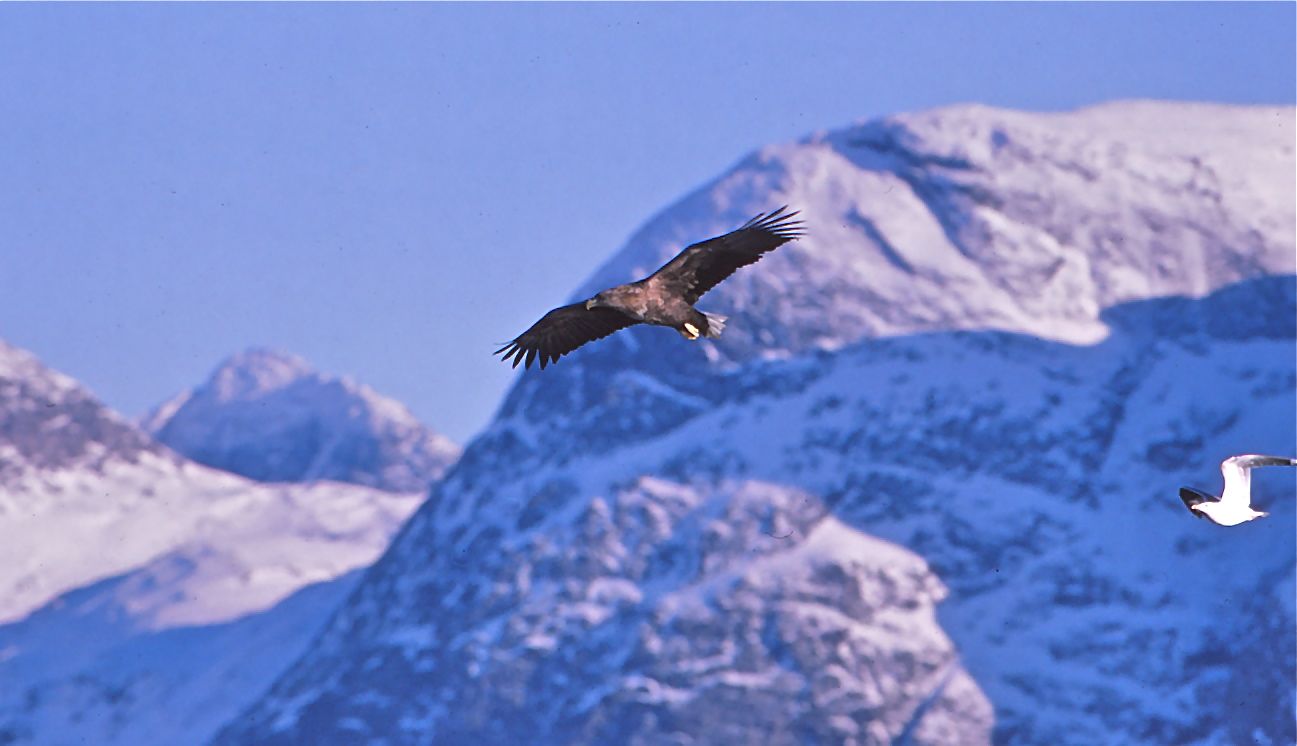
| sea eagles are such impressive birds - c. Mike Read |
All good things come to those
who wait … so they say, and I’ve wanted to return to Norway ever since I filmed
sea eagles there for the BBC nearly forty years ago. So Sue and I were embarking on a
trip down memory lane, to enjoy 2,500 nautical miles of beautiful mountainous
coastline in a Hurtigruten ferry in the hope of seeing these legendary eagles
once again.
 |
| Hurtigruten on the move in Norways' beautiful Lofoten Isles |
The film I made all those
years ago was for the ever popular David Attenborough series called “Wildlife
on One” and would tell the inspiring story of the re-introduction of the
white-tailed sea eagle to Scotland.
Although it had been a
widespread breeder in the good old days, egg collecting and persecution had
wiped it out and although attitudes to wildlife have improved dramatically in
recent years, there was no guarantee that this attempt would be successful.
The plan was to capture young
eagles from nests along the Norwegian coast, fly them over to Scotland, grow
them on in cages on the remote Hebridian island of Rhum and when fit and
strong, release them into the wild.
 |
| scenery to die for - every day |
My task in 1980 was to show
how the eagles survived in both summer and winter along the rugged coast of
arctic Norway. We were based to the north of the Arctic Circle in Bodo, often
described as ‘the sea eagle capital of the world’. It’s a title that proved to be well
deserved.
I was assisted by Sigbjorn, a
local Norwegian wildlife enthusiast. It’s a long time ago but I vividly
remember his comment as we walked by the harbour and were confronted by two of
the most gorgeous girls either of us had ever seen. Sigbjorn shook his head and
said “sometimes a young man wishes he was blind”!
Anyway, back to the eagles.
The eminent scientist and local eagle expert Harald Misund had located a
suitably remote nest on an offshore island cliff edge that provided a safe home
for a couple of hungry youngsters. Sigbjorn took me out there in a small boat
every day for a week to film the youngsters being fed by mum. It seemed they
grew larger by the hour.
 |
| cruising silently past eagle cliffs |
 |
| otters love tucking into lumpsuckers and there's always lots of 'leftovers' |
On one notable occasion it
was late evening when I noticed an otter far below the cliff top eyrie and I
wasn’t alone in seeing it. The chicks were dosing but Mum was alert and
watching the otter intently, even more so when it dragged a large lumpsucker
ashore. As I filmed the otter eating it I knew from my filming days with otters
in Shetland what would happen next and so did the eagle. Lumsuckers are large
fish and when it had eaten its’ fill, the otter left the remains and curled up
beside it to sleep.
I quickly re-focused the
camera on Mum, just in time to film her leap off the nest and plunge down the
cliff with folded wings. Seconds later she swung her impressive talons forward,
grabbed the fish from under the surprised otters’ nose and returned to the nest
with her stolen prize.
The feast was enjoyed by all
three eagles so I had a memorable sequence in the can … and just in time,
for it was already midnight and Sigbjorn was due to collect me at one o’clock.
One of the great advantages of summer in the arctic is the twenty-four hours of
sunshine that allows very long days for filming.
 |
| north of the Arctic Circle it's the land of the midnight sun |
However, this particular day
was longer than planned. I’d already been in the cramped hide for fourteen
hours, was out of food and water and keen to return to my bed. Sigbjorn didn’t
show up at one o’clock or until past seven in the morning. He was apologetic
and I was too much of a gentleman to ask if he’d actually caught up with one of
those drop dead gorgeous girls we’d seen in Bodo, or maybe both!
 |
| what a beautiful backdrop to a weeks frost-bitten finger filming |
Winter survival was an important
part of the sea eagle story so I returned the following February to film them
catching fish in the famous rapids near Bodo called Saltstraumen. This narrow
neck of a long fjord sees millions of gallons pass through on every tide change
and so fierce are the currents that they create deadly whirl-pools that fling
fish up to the surface, rupturing their swim bladders.
Unable to dive again, they
struggle on the surface and provide a perfect target for hungry eagles. They
also provided me with a good opportunity to film some impressive swooping and
squabbling but first I had to
reach the island in the teeth of the treacherous tide-rip in a small boat - and in the dark - to a
driftwood hide before the eagles woke up.
 |
| strike force - c. Mike Read |
It was a perfect spot for
hungry birds and I counted as many as forty three eagles roosting in the
surrounding trees, most of them youngsters. Aerial battles were numerous as
they squabbled for fish but I had also baited the rocks in front of the hide
with dead fish and this proved popular with them too, especially as I’d tied
them down so they couldn’t be removed from in front of my lens! And the
background for all this action were stunning, snow covered four thousand foot
Alpine peaks.
 |
| the famous tide rip at Saltstrumen - my hide was near the tip of the island below |
Despite suffering ice-covered
fingers in the sub-zero air, the necessary hardship gave us a memorable
sequence but we strived for even better. We hired a fishing boat to take us out
into one of those classic Norwegian fjords called Mistfjorden, it’s deep blue waters
reflecting snow covered peaks in the mirror calm.
No eagles were visible as our
fisherman Yohanis started throwing a few dead fish out but it wasn’t long
before these were spotted by far off hungry eyes. Leaving their lofty mountain
perches, three eagles were soon circling the boat. They seemed suspicious of
these free meals, keeping their distance until the pangs of hunger drew them
ever closer to our camera.
 |
| I had to grab the film-camera when it started to swoop so no fishing pics from me |
Sweeping down on their
massive folded wings, they swung their outspread grappling-hook claws forward
and with a rushing of air and a splash, lifted their prize clear of the water.
Within minutes they were gone again, rising up the mountain cliffs with
effortless grace to enjoy their meals in Arctic solitude. It was a stunning
spectacle.
 |
| a successful catch - c. Mike Read |
The Norwegians are admired
for their concern for wildlife and conservation … we won’t mention whaling or
salmon farming … but it wasn’t always so and they resented sea eagles catching
their fish. Remote communities without guns devised a cunning alternative –
capturing the eagles by hand! – and we were keen to re-create the technique.
This involved going by boat
to the beautiful Lofoten Islands in the dead of winter when the eagles were
desperate for food. We created a tomb in the mountainside rocks for this
freezing cold cameraman to hide, then baited a stone with fish just in front of
the camera. The narrow slot was just wide enough for the would be persecutor to
thrust his gauntleted hand out and grab the eagle by the legs and having done
so, an accomplice would leap out of the hide to control the wild stabbing of
the birds axe-like beak.
It sounds unbelievable but
the technique worked and many eagles died … and we proved it could still be
done by filming an eagles feet just beyond the end of the lens as it feasted on
the bait. I didn’t wring the bird’s neck of course though felt like doing so
after waiting many hours in my icy tomb. By ‘eck it was cold.
Almost as memorable for a
young man … I was one once … we’re the two beautiful girls we met on deck on
the ferry back to Bodo. They seemed to be enjoying the blizzard if snow as much
as Richard and I so I asked one of them if they’d like to join us for a pizza
in the famous SAS bar in Bodo. She looked me straight in the eye and said
“what’s your motive!” I obviously gave her the wrong answer as they never showed
up … and even after all these years I still wonder what the correct answer was!
 |
| eagle country all around |
The all important capturing
of eagle chicks for the re-introduction to Scotland was in the hands of
Norwegian sea eagle guru Harald Misund. He knew all the local nests and only
selected sites where there were more than one chick, so it was with him that I
climbed a steep hill to reach a large nest containing three eaglets. They eyed
us with suspicion as we approached, then threatened us with their huge talons
as the anxious adults circled above us, yelping loudly. Two eaglets were
bundled carefully into sacks and carried quickly downhill then placed into
boxes where the darkness soon settled them down. Within days, eight chicks had
been selected for transport to Scotland with the RAF, supervised by long time
friend, Roy Dennis.
Release pens had been built
on Rhum, the birds’ development looked after by the dedicated care of John
Love. 'Hacking' them to fitness was an intricate process but after several
weeks they were fit and strong and familiar with their surroundings. Now they were ready
for release and I was there with a high-speed camera to record that magic
moment.
The chosen ‘first flight
star’ sat relaxed on a large rock before the removal of it’s hood revealed
those fierce all seeing yellow eyes. A quick glance around before those great
wings unfolded and swept the eagle over my head and off into the freedom of
wild Hebridean hills. It was a moving moment and a triumph for all concerned.
After a hundred years, history had been created. Sea eagles had returned to
Scotland.
Fifty years on, the vision of
many has proved a resounding success for as I write, dozens of pairs are
raising young in the glens along the west coast and further introductions have
created a separate population in the east of Scotland with birds moving back
and forth across the Central Highlands. It is always heartening to hear of
success stories in wildlife conservation and this is one of the most notable.
 |
| focused on food - c. Mike Read |
To see these great birds
given a chance again, gliding above the mountains or sweeping over an estuary
to catch a barnacle goose as we did on Islay last winter is to feel elated at
the power of nature’s recovery.
Sue and I had always wanted
to travel on the famous coastal steamer and we were pleased we did, for the
ferry we were on called Nordnorge was really comfortable, with a great crew and
excellent food and the beauty of the scenery is stunning. Hurtigruten claim it
to be the most beautiful voyage in the world and now we’ve sailed those seas
it’s easy to agree.
I’ve had the privilege of
travelling the Alaskan coast and it’s mountains and glaciers, the Chilean
fjords, even the Antarctic Peninsula and stunning as they all are, Hurtigruten
takes the biscuit, a whole packet!
We spent years saving up our
pennies because we planned to travel from Bergen in the south to Kirkenes in
the far north, tucked in alongside the Russian border, then back again. On the
way we would fulfil our long held ambition of visiting my old sea eagle haunts
north of the Arctic Circle.
 |
| one of the fastest tide rips in the world |
They always say you should
never return to the scene of past triumphs and our recent trip on Hurtigruten
partially proves the point. Jumping ship in Bodo, we joined a coach outing to
the famous Saltstrumen. It was the most beautiful spring day, the tide still
ripping crystal clear water through the narrows, eiders still diving
enthusiastically for mussels but of the eagles there was no sign. Time had also
seen the inexorable pressure of tourism change the area to an ‘attraction’
instead of the icy winter wilderness that I vividly remember.
I only saw one eagle on the
way north to Bodo and in spite of
the Lofotens looking as beautiful as anywhere in the world, we didn’t see
eagles there either. Mind you, our planned eagle safari on the way south was blown
out by a gale and rain, so we were unlucky.
 |
| we only had a couple of days of dodgy weather |
 |
| for days on end we glided through sun drenched calm seas - perfect |
However, for eight days on
the way north we were blessed with warm sunshine, calm seas and some of the
best food you could ever wish for on a holiday - or anywhere else.
 |
| 'sunny side up' - the food was excellent - the staff charming |
What’s more Jon Hennli the
ship’s Hotel Manager entertained me with hunting, shooting and fishing stories
so I learned a lot about the countries’ wildlife. I could have sat with him on
deck all day swapping stories but he was running the ship and a tad busy!
 |
| friend John Hennli on the left with the skipper on Norways' independence day celebrations |
 |
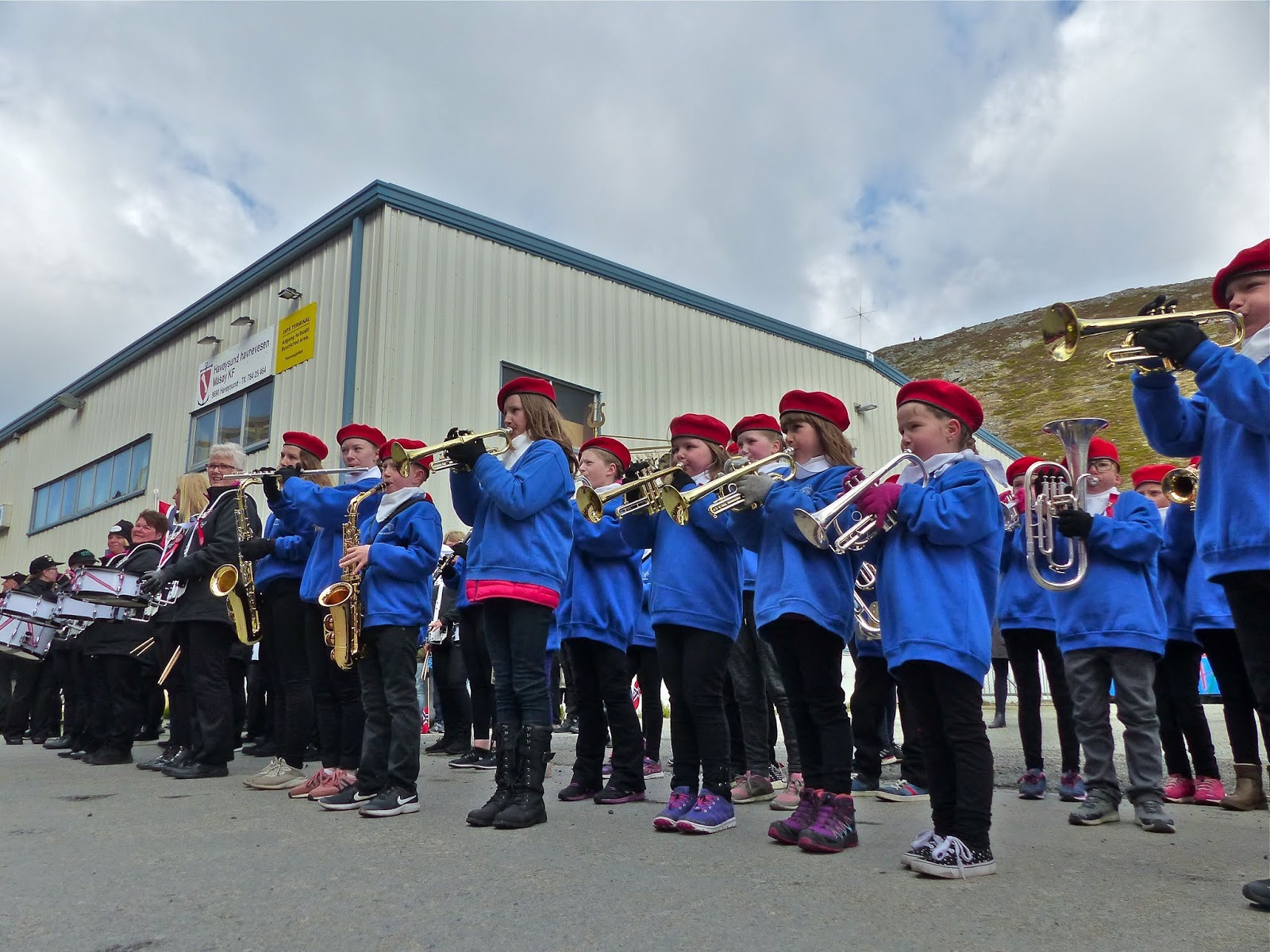
| greeted by singing school children |
We made sure we booked our
trip to be on the ship for Norway’s National Day of celebration and delightful
it was too, greeted as we were at little towns by singing school children and a
band at another, with lots of flag waving everywhere. It was a happy day,
enjoyed by us tourists and even more by our crew.
 |
| the island of Hornoya just offshore - the most easterley point in Europe, level with Istanbul |
Our sighting of 38 species
isn’t many but they do represent true quality over quantity, proving that the
familiar can be as exciting as the rare. Take for instance a day when dozens of
pink-footed geese were migrating north to their breeding grounds in Svalbard,
the last skein memorably lifting over the 3,000ft peaks of Lofoten at midnight.
 |
| towering mountains in the Lofoten Islands |
 |
| barnacle geese on the Hebridian Island of Islay, land of the famous malt whisky |
Then there were family
parties of barnacle geese grazing the tidal marshes on their way to their
remote cliff-edge nests in Spitzbergen. I love wild geese because of the places
they remind me of in their passing and where I’d enjoyed adventures with them
in the past. These two transported me to those inspiring wildernesses in a wing
beat.
 |
| the Arctic summer is short so barnacle geese have to lay their eggs before the snow has melted |
On yet another benign
windless day of calm blue sea and sunshine, seven harbour seals drifted past us
at intervals, their languid breathing revealing their presence and identity.
Far more exciting were the two long-tailed skuas that travelled alongside them.
I hadn’t seen this species since 1985 when I was filming for the BBC in NE
Greenland.
Our series was called
“Kingdom of the Ice Bear” and my assistant Mike Read and I had arrived before
the snow melt so we could film the story of the brief Arctic summer. Barnacle
Geese were one of our stars and they’d just arrived to establish their rights
to cliff-top nesting ledges, despite still being covered with snow. In the
valley below them, a lemming had just emerged from its’ long winter sleep under
the deep drifts, blinking at the sudden dazzling light.
 |
| a long-tailed skua ... such a special bird ... but not to a lemming |
It was dozy and unaware of
the danger as a long-tailed skua had spotted this potential meal and was sneaking
up behind it, about to pounce. The lemming suddenly became alert, swivelled
round, stood as tall as it’s little body would allow and in boxing mode, eyed
it’s attacker and waved it’s paws at it, chattering aggressively. The skua
decided there might be easier meals elsewhere, so the lemming survived and we
gave a cheer of delight.
So in a few brief moments,
wildlife beside the Hurtigruten ferry can transport you to foreign lands and
memories of decades past. Perhaps being on the move keeps your mind alive.
 |
| the hole in the rock is purported to have been created by a Viking arrow - nice one |
All this and the spectacular
scenery was viewed from what we likened to ‘a magic surf-board’, gliding
silently over the crystal blue waters. So would we agree with Hurtigruten’s
claim that it is ‘the world’s most beautiful voyage’? Indeed we would …
 |
| it's difficult to imagine a more glorious journey |
…and of the sea eagles return
to Scotland? Well, my friend from Greenland Mike Read was on the island of Mull
last week, [he supplied the eagle pics used in this blog] an island close to
the eagles’ original release site and on one day alone he saw no less than
sixteen eagles.
 |
| so wonderful to see these great birds back in Scotland - c. Mike Read |
What’s more, the island can
boast a total of twenty-one pairs
of eagles and along with the rest of the islands impressive range of critters,
wildlife tourism is worth £5 million pounds every year to the rural economy and that's on Mull alone. So
the return of sea eagles from Norway to Scotland has proved a resounding
success. Happy days!
Further reading :
John Love's book is a great read and well worth finding in a library, full of detail about this historic re-introduction and lovely illustrations too.
To join photographer Mike Read on his guided tours of Mull visit :
www.mikeread.co.uk