Saturday, 9 March 2013

MULLET MADNESS - ANGLING ADVENTURES 3


the intense anticipation of an estuary dawn
Mullet! If there is a fish that fights as hard pound for pound, I’d like to hook one. My international angling experience is very limited of course but I’ve caught mahseer and bonefish, along with catfish in Africa, also barbel and carp in the UK and non of them hold a candle to mullet. Hook one among a tangle of boat anchors and they soon have you crying for mercy like a baby.

a 'big' one - the wide angle lens works every time!

Bonefish go like a rocket when hooked in the shallow water, striping dozens of yards of line off the reel and bending your fly rod into an alarming curve. They might do this two or three times but then they are done.

Mahseer have weight and a fast current to aid them as they try to pull your arms out of their sockets, but they are soon subdued by the powerful tackle.

Mullet on the other hand just never give up and even when you think they are beaten and coming towards the net, you usually have another five minutes or more of arm and heart ache before the battle is won … that is if they haven’t smashed you already or come off, an all too frequent occurrence. Mind you, we are usually using 4lb line as we’re always hoping for a decent roach or dace, both of which flourish in Christchurch harbour, our usual haunt for these exciting adventures.

'X' marks the spot?
Terry with a biggie
Our legendary friend Terry Lampard told me not long ago that if he could only fish for one species for the rest of his life, it would be mullet … and there can’t be a better recommendation than that, bearing in mind that Terry caught monsters of almost every species that swims in the UK. He had three thick-lipped mullet weighing more than eight pounds in his all too brief lifetime – quite a feat considering most catches are thin-lips of around two to four pounds.

shared sunshine and laughter - perfect
a nice one for Brian
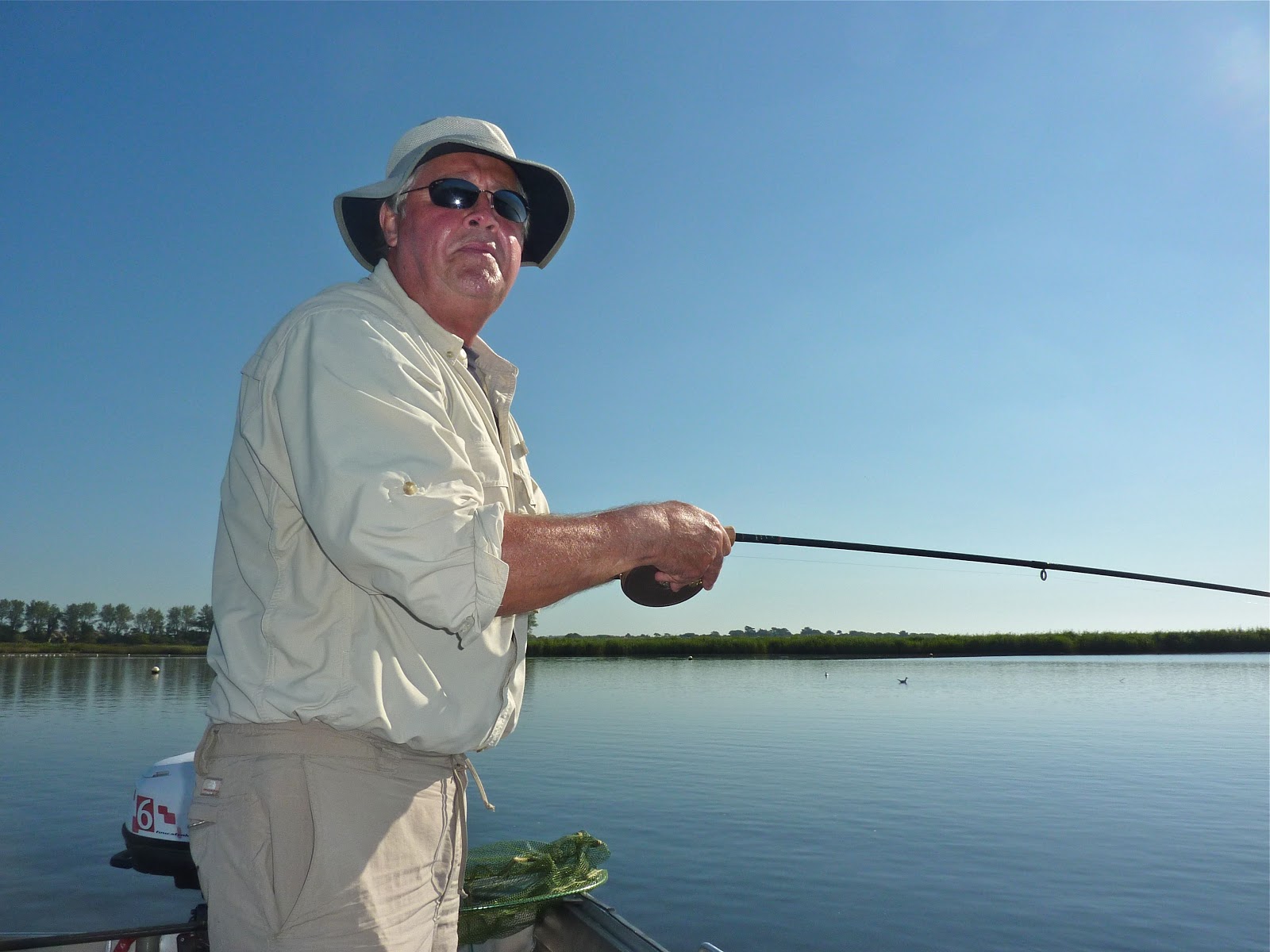
Mullet are supposed to be almost impossible to catch but as you'll see from these smiling faces, they are only 'exasperating'. I go out on the estuary as often as possible in the summer and last year was no exception, joining either my regular fishing pals Trevor Harrop - or Steve Derby from ‘up north’ – Brian Naylor from Norfolk too. 

Steve with one of many
When I first took him out in 2010, Steve enjoyed it so much that he bought himself a rig so that he could take his mates out there to share in the fun. I too love exploring the wide-open spaces, rowing out in my little10ft. dinghy reminiscent of my childhood on the Norfolk Broads. I even cut a cupboard out of my VW van so that I could slide the boat into the back and not have to bother with a trailer. In and out of the water in minutes – perfect.
Steve's rig - heading down the Stour to the estuary

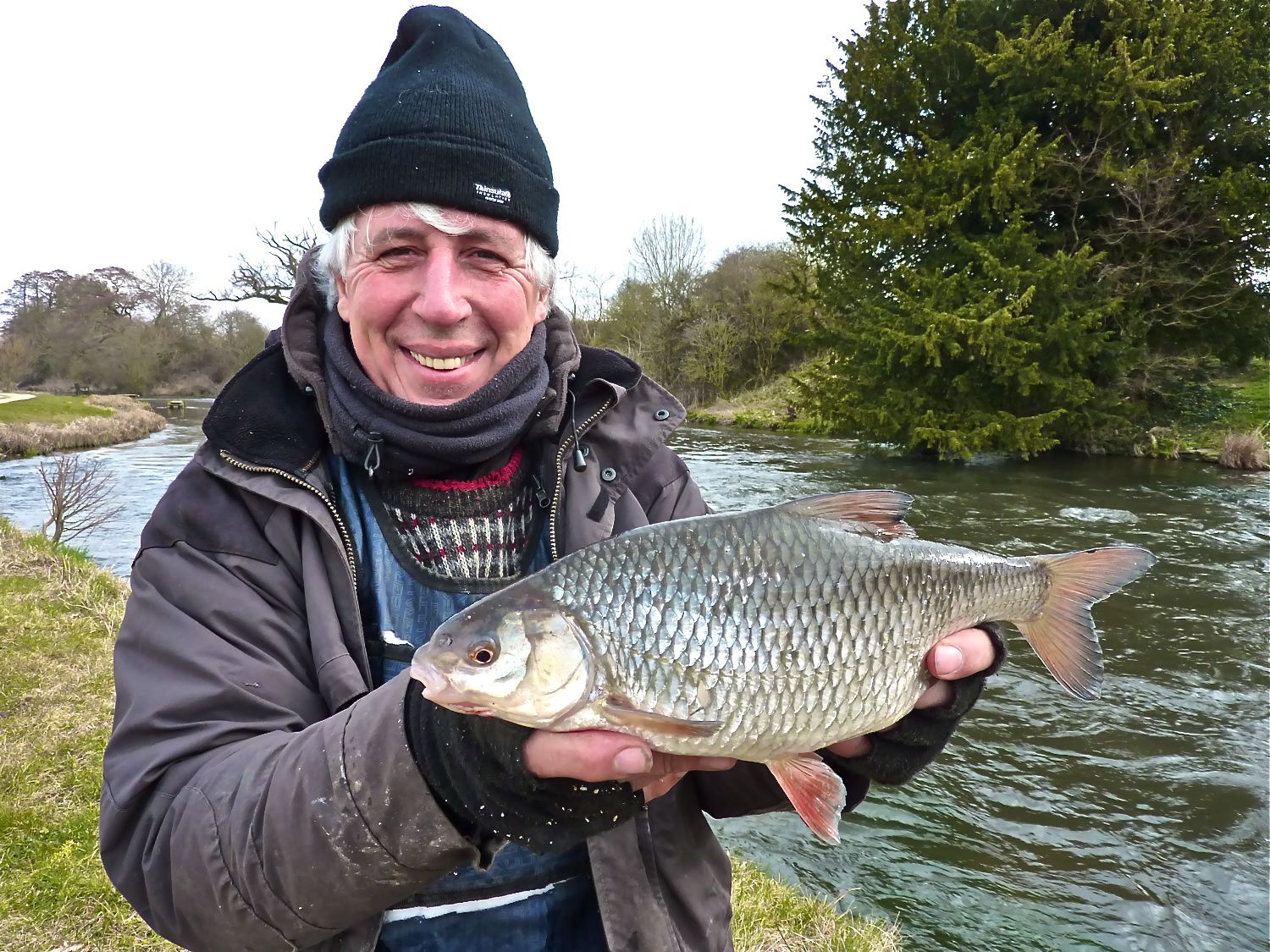
Scale perfect - one of Trevor's roach
Trevor and I are keen roach anglers, so as mentioned above, we usually compromise our tackle by using 4lb line straight through to a 12 hook, using a  pin and a tench float rod or similar [shortish due to being in a boat,] and something like a crowquill avon float. It’s classic trotting, easing the flake through the bread mash groundbait. We are always hoping for roach but also praying that we don’t get taken apart by a mullet. On one memorable day last year Trev. and I shared a catch of 11 mullet, along with numerous roach and dace. It’s perfect social fishing, sitting side by side sharing a swim and the triumphs, along with being able to laugh at your mates missed bites and disasters.

Steve getting tense
In crisis now - it's reached the boat channel

and it wasn't even a big one


Steve and I were lucky enough to be out there during the Bournemouth Air Show, so we enjoyed the bonus of fly-pasts of famous aircraft just over our heads ; more than adequate compensation for blanking!


Last year, after a long and violent battle, I landed a mullet which was well over 7lbs. Steve’s best was just over seven and this was bigger than that but the float got caught in the broken rod tip and while trying to untangle it, the mullet escaped out of the landing net before I could weigh it. Then on another occasion I hooked a mullet that took me right across the harbour and I had to sink the rod down to the butt under the waves so the keels of the passing yachts didn’t cut me off. God knows how big it was, the fight continuing for quite a while before it broke me on a snag. I was left quivering with excitement – and dismay!

another cracker for Martin
Friend Martin Bowler uses 6lb line straight through and doesn’t seem to lack a response from the mullet … and though maybe he doesn’t catch as many roach as us, he probably doesn’t get broken by so many of the mad fish either.


not exceptional in size but they are all beautiful
Traditionally, the ebb tide is the time to fish but in truth it doesn’t seem to make much difference because most of the time you don’t catch anyway. As I often quote when inevitably struggling to understand the endless variables, ‘there are so many questions … but no answers’!

Running through above the bottom, tripping through, holding back, stret-pegging or even laying hard on the deck all work … but only sometimes! It is a wonderful challenge out there in the wilds and when you do finally hook one and it doesn’t fall off, you have a long battle on your hands to subdue these muscular fish.

as the tide drops they eat the groundbait - bless 'em
The wildlife watching is good too, with large flocks of birds and one day Trev. and I saw an otter swimming under Tucton Bridge, ignoring us, another friends boat and the rush hour traffic above it’s head. We sometimes catch good roach up to about a pound, big dace, lumpy bream, lively sea trout and even bass, so there are always plenty of surprises. Then there’s the sun and wind, the boats going past too fast, the wash, the waves, the tides, the swans and the noise. By the time I leave the water I often feel like I‘ve spent several hours in a tumble dryer, but with lots of excitement, laughter and good company thrown in. I always sleep well after a dose of ‘mullet madness’.

We hope you’ll enjoy this clip from our series ‘Catching the Impossible’ Prog 9. I think it captures the crazy fishing well – poor Martin!


Saturday, 23 February 2013

TERRY LAMPARD - A TRIBUTE - 1947 to 2013


What very sad news, the loss of such an inspiring, gentle and kind man - and like many of us no doubt, I find it difficult to believe that he isn't still out there on the river, waiting to pull off yet another awesome conjuring trick.

                 
Terry's 7/4 River Stour chub
                                    
We all know that Terry  was a great angler but more than that, he was simply a lovely bloke, always full of fun even when he had his sights firmly set on a giant fish. 

Typical Terry - out there with a few of his many friends + big fish of course.

I was very fortunate to share experiences and favourite swims with Terry in the good old days when we were pursuing 3lb roach on the River Stour at Whitemill Bridge. He was always generous with his stories and optimistic about the prospects, even after we had both blanked, a familiar occurrence when hunting those elusive monsters … though of course, he blanked a lot less often than I did!

Virtually the only other angler I saw in those rock hard days was his very close friend Tim Norman, so I always felt honoured to be sharing the same challenges as these two wonderful blokes. Do read Terry's descriptions of those inspiring winter days on the Stour in his book ‘First Casts’ – as good a book on fishing as you are ever likely to read.

Terry paid Martin Bowler and I the honour of agreeing to help us with the filming of ‘Catching the Impossible’. We set him the challenge of catching a seven pound chub … certainly not ‘impossible’ for a man of his 'kaliber'!  After all, he had already caught so many he had lost count … and that is not a suggestion that he ever showed a hint of false modesty. He was just good at it!

But catching a seven pounder to order with the camera clunking about on the bank, well that is just a little more difficult. We enjoyed many happy hours together trying to hit the target and these even turned into days … but in the end of course his legendary perseverance paid off … as can be seen in the film clip from the series.

Then we did set him an impossible task, a three pound roach but from a river! Martin and I considered this to be the only truly impossible target in the series, the title just being a device to help us tell the story. Tim and Terry even doubted there were still any three pound roach left alive in the River Stour, let alone being able to catch one but they generously gave it a go and needless to say, Terry turned our dream into reality. It was one of the happiest moments in angling that you could ever imagine. 
a 3/5 river roach - impossible!
No doubt I’m not alone in thinking that everyone who ever met Terry will miss him deeply. What a lovely man.


We hope you’ll enjoy watching Terry doing what he did best - catching monsters. He’s probably still out there in a favourite swim, catching even bigger ones!

Monday, 18 February 2013

ACTION ON CORMORANTS - PROTECT OUR FISH


Maybe beautiful if painted by one of wildlife's leading artists.


Nearly 2lbs from the Avon and still alive.


It takes ten years for a prime roach like this to grow to 2lbs. It takes a cormorant two minutes to consume it. Roach are in big trouble because they are running out of time.

PREDATION is a provocative word these days, even if it is a fundamental part of any healthy ecosystem. Perhaps our sometimes hostile attitude stems back to ancient times when predators used to eat us!
The eyes might have it but it's the nose that finds the prey.
I’ve filmed more than enough predators that could have eaten me if I hadn’t been paying attention but I loved them because they create dramatic stories for TV audiences.

A male tiger - big enough!

Tigers still consider humans legitimate prey, though this large male was not killed for eating one of us. A competing male had moved into the territory where we were filming, killed this tiger then ‘our’ female, who died trying to defend her cubs from him. He eventually killed a local who was gathering wood in the forest.

Makes the heart miss a beat c. Stanley Breeden


.
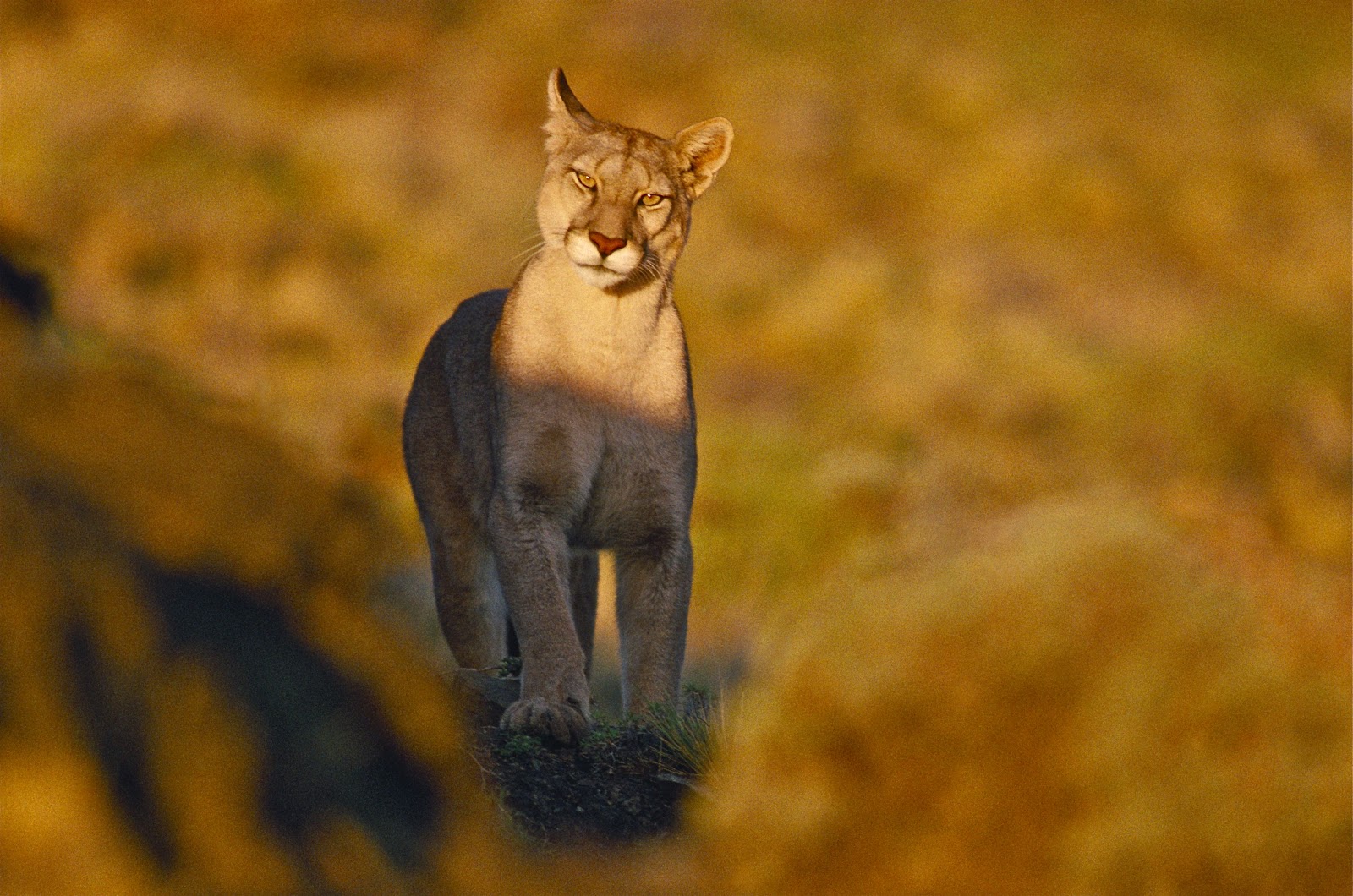
A mountain lion or puma - one eat a fisherman just after I'd finished filming c. Laurie Campbell
Apart from tigers, mountain lions kill one or two of us most years, grizzly bears likewise. There are always polar bears that threaten adventurous travellers, crocs can be deadly and if we are to believe some TV programmes, even fish have a nibble once in a while. But these are the freak show exceptions. 
Even a dentist might flinch at this mouthful c. Carl Englander

The truth is that it’s a dog eat dog world out in the wild and there is always something eating something else. We all know that pike eat perch and perch eat roach and roach eat little critters and some of us were hostile when fish eating zander where introduced to the UK, even leading to culling ... and in the bad old days we were  even encouraged to kill pike, so in spite of our possible hostility, predators are a natural part of our everyday life by the water.

A gripping story c. Jonathan Scott

At risk of stating the bleeding obvious, predators need prey and prey need predators, otherwise there wouldn’t be enough food to go round. In most healthy ecosystems, it’s the prey that control the predators … for without prey, the predators would starve and die. 


One classic and familiar relationship is the lions and wildebeast in the Serengeti. 


Leap of faith c. Jonathan Scott


Without the lions and crocs reducing their numbers, the herds would soon run out of grass and conversely, if the wildebeast fail to complete their migration to Kenya, the lions die.

Quenching your thirst comes at a price c. Deeble and Stone

Tempers flare when food is scarce c. Jonathan Scott

Problems arise when the balance between predator and prey is lost and that is exactly what is now happening in our rivers and lakes. Predators have eaten so many fish that some species like roach are in serious decline and this becomes even more critical when the prey species are so low on wildlife enthusiasts radar that they don’t even notice. 


Avon roach at Britford.
Fish are the great ‘unseen’ in our countryside - literally out of sight, out of mind. It’s only anglers who are aware of them and care about them and so it’s up to us to do something when the predator/prey relationship goes wrong.

They sometimes look quite cute?!


Ringing recoveries show where the cormorants are coming from.
Most anglers are now aware of just how much damage the winter invasion of between 20 to 30,000 cormorants from the continent do to our fish life and if scientists are correct when they say that each cormorant requires about a pound of fish each day to just survive, [not to raise young], then that means that throughout the winter, 20,000lbs of fish are removed from our waters every day.  


That deadly hooked beak.
So in four months, cormorants eat more fish than the largest fish farm in Europe produces in a year! This is surely unsustainable and must be damaging our biodiversity and this is exactly what has happened.

As the British Trust for Ornithology graph shows, cormorant inland breeding numbers have also increased from nil in 1980 to 2096 pairs in 2005, so there is no escape from the plunder, even in summer.


All of the above are the ones that survived the attacks.
The Hampshire Avon was once famous for it’s thriving roach populations but two recent Environment Agency Surveys shows just how dramatic the decline has been since the increase in cormorant predation. 


Missing millions from the Hampshire Avon.
The graph indicates roach presence in yellow and highlights the almost complete absence of them from the middle reaches of the river, historically their stronghold. Not content to see the river die, a group of us passionate roach anglers, led by Trevor Harrop and Budgie Price of the Avon Roach Project wrote a petition ‘Biodiversity in Danger’, raised 16,000 signatures and with the Angling Trust now supporting us, delivered the petiton to the Minister, Richard Benyon.


As a result of this and pressure from the Angling Trust, a  government review into the cormorant problem has been carried out by DEFRA. We are hoping the minister will place the cormorant on the general license, thus enabling river keepers to protect their fisheries more easily when and if necessary. We are expecting a decision in the next few weeks.


Decline of roach catches on the Dorset Stour.

Some of the evidence of declines put forward to the review group is alarming. For instance, I compiled this summary of the dramatic fall off in catches at the once famous roach fishery on the Dorset Stour at Wimborne, based on ten years of match results.

Cormorant increases in Germany.


Recent scientific reports from Europe show the extremely rapid increase in cormorants there … and they will be heading our way sometime soon. Cormorants are a big problem in Europe but it’s not clear why they have reached these epidemic proportions.

If you add all the other threats to our rivers … abstraction, pollution, siltation, American signal crayfish eating the fish eggs, hydro schemes, loss of habitat and not least climate chaos leading to dramatic floods or drought, then fish life has never had it so bad … and don’t blame the Environment Agency. They are doing everything they can to help our fish populations and have achieved impressive results in our neck of the woods. Alas, recent cuts in funding is limiting their ambition.

Everything in nature is complex and I bet it isn't only the cormorants that are to blame for the declines. Apart from those problems listed above, there are chemicals from trout farms and cress beds and even more important I believe, the loss of the refuge and nursery areas provided by the derelict water meadow carrier systems. Then if you add us humans to the equation the solutions become almost impossible. Suggestions by the RSPB that we should leave tree cover or build fish refuges in rivers are sensible if such structures weren’t removed by Natural England to provide better habitat for wading birds or by the EA to alleviate the risk of flooding. We humans have done so much to destroy our wildlife that it is no longer an option to do nothing.


Article in recent issue of BBC Wildlife.

I recently contributed to an article in BBC Wildlife ‘Licence to Cull?’ about perceived ‘troublesome’ species like mink, wild boar, deer, ruddy duck, badgers, grey squirrels, corvids, even hedghogs and yes, cormorants.


Predator eats predator - perch for breakfast c. Steve Allen
During his research, James Fair, a very experienced senior editor wrote that ‘in any discussion of culling, it’s noticeable that birds tend to have more friends than mammals’. So were does that leave our fish – with no friends at all? Us anglers need to tell the world what is happening out there, to work with the Wildlife Trusts and the RSPB, to get them to listen to our cries of help. If most of the wildlife protection organisations weren't so ignorant about fish,  admitted that there is a problem and stopped being in denial then our task of finding solutions might just be possible.


Another perch bites the dust c. Brian Bevan
I suspect there is a hint of 'anti-angling' in some organisations and if so, then it's up to us to tell them all the good work we do for our rivers and lakes. Through our rod licences and voluntary help we put at least twenty five million pounds back into the environment and all wildlife benefits from our care and attention. Without us there will be even fewer fish and as a result, fish eating birds and mammals will suffer. 


More than a mouthful of pike for this great-crested grebe.

So rise to the challenge and involve yourself with your local wildlife trust like I have. It doesn't take long to tell them about how important fish life is to their treasured freshwater ecosystems and what us anglers are doing to help. We all need to work together on behalf of our wildlife and that includes fish.

Big bill.

What every one of us can do is join the Angling Trust and the Salmon and Trout Association so at least our combined voices can be heard in the corridors of power. It helped us to progress with the cormorant problem so lets hope the Minister comes up with a solution that allows our fish stocks to start making a recovery. We are up against a million RSPB members but there are more of us than them, so just join us and get your voice heard. Membership costs very little but the results can be impressive : http://www.anglingtrust.net/

Nearly a Test two for Martin.  


Below is a film I made with the Avon Roach Project and Martin Salter for the Angling Trust, ‘Action on Cormorants - Protect Our Fish' :
http://www.youtube.com/watch?v=9BjkOPvmzmQ&list=UU6PLLOmayfIppI-X-c73bMg&index=1